Most events don’t fail because people didn’t show up. They fail because people showed up and had nothing to do. Attendance is a low bar. What separates a forgettable event from one people talk about afterward is what guests actually did while they were there.
Why Engagement Is the Real Metric
Every event type has its own version of this problem. At a conference, attention drops the moment a session turns into one-way information delivery. At a trade show, a booth without interaction is just furniture with signage. At a wedding, the gap between ceremony and dinner is where guests either connect with each other or check their phones. At a retail activation, a shopper who isn’t given a reason to stop simply keeps walking. Corporate marketers plan launches to leave an impression, but impressions fade fast when guests only watch. The ones who leave with a story, an object, or a photo they took part in creating remember the brand longer than the ones who stood at the edge of the room. College audiences are especially unforgiving of passive formats. They’re used to choosing their own entertainment, so anything that resembles a lecture loses them within minutes. Exhibition organizers deal with a similar dynamic on the floor: visitors decide within seconds whether a booth is worth stopping at, and that decision is almost always based on whether there’s something to do, not something to read. The through-line across all of these settings is simple. People remember what they participated in, not what they observed.
Engagement Methods Worth Considering
- Personalization consistently outperforms generic giveaways. A name added to a gift, a recommendation tailored to the guest, a small custom detail changes how a person values what they’re given. This is worth its own closer look, since it has grown into one of the more effective categories available to planners today.
- Games and light competition work because they turn dead time into activity. A trivia wall or a small challenge at a booth draws a crowd not just because people want to play, but because watching someone else play is its own kind of engagement. This suits high-traffic settings like trade shows and college fests, where the goal is stopping power.
- Live demonstrations persuade in a way that brochures can’t. Seeing a product built, cooked, or used in real time answers the question a guest is actually asking, which is usually whether it really works the way they say it does.
- Hands-on stations, whether a craft table or a build-your-own setup, keep people physically present longer. Guests linger where their hands are occupied, and that lingering creates conversation with whoever’s standing next to them.
- Workshops trade volume for depth. A short cooking demo, a product walkthrough, or a hands-on tutorial gives attendees something to learn, not just watch. These work best when the audience already has interest in the subject, since a workshop with no relevant crowd just becomes an empty room.
- Photo booths and social walls remain reliable because they ask almost nothing of the guest. A booth captures a moment, and a live social wall shows guests their own posts on a screen, which quietly encourages more posting. Both work across nearly every event type, from weddings to product launches.
- Structured networking solves a problem most professional events never admit to: people don’t naturally introduce themselves to strangers. A simple prompt, a roundtable format, or an icebreaker built into the agenda does more for actual connection than an open bar and a hope that people will mingle.
Live Printing and On-Site Personalization
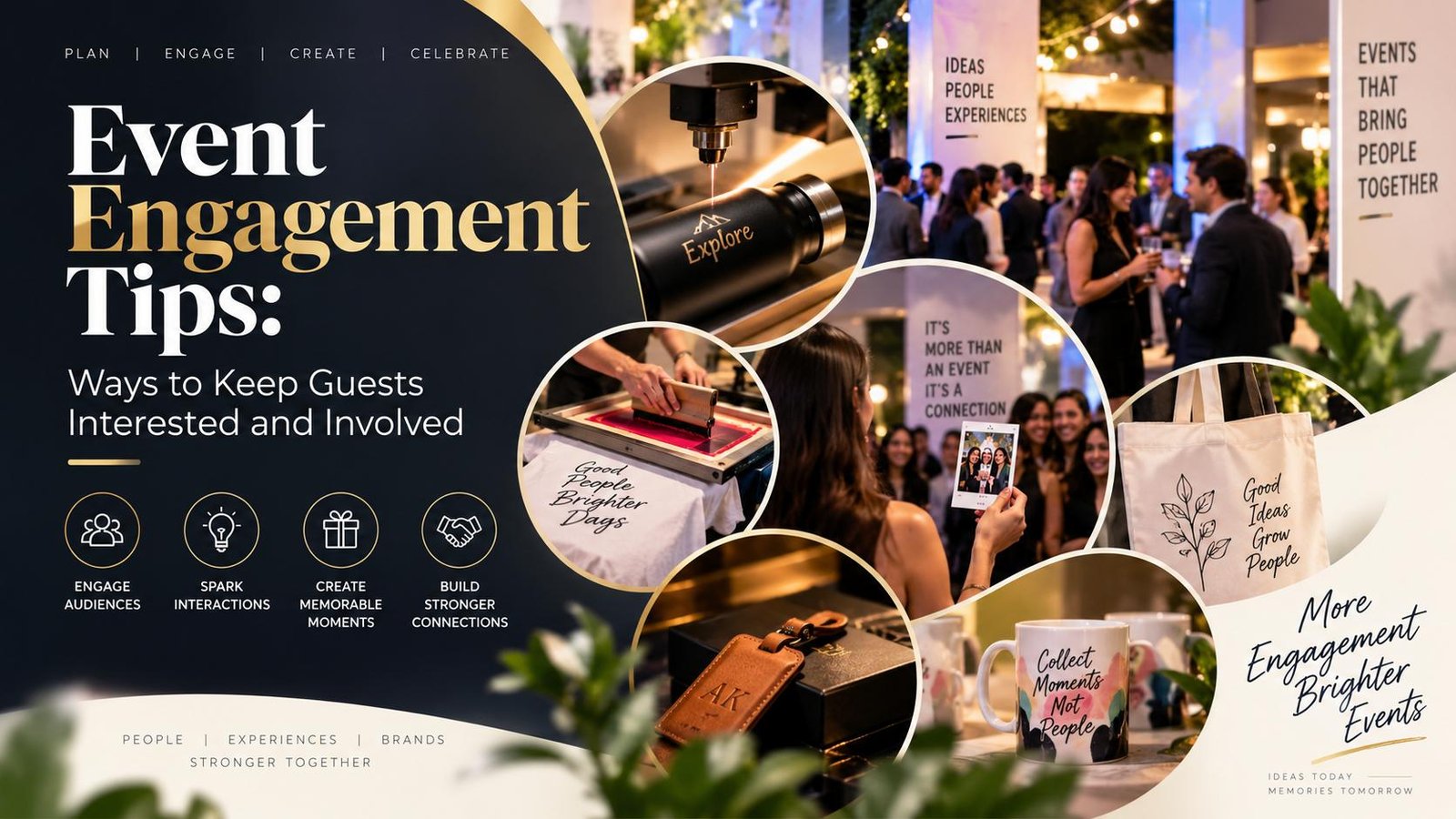
This category deserves attention on its own because it solves a specific problem: branded merchandise that nobody wants. A tote bag or pen with a company logo has almost no personal value to the person receiving it. The same object, personalized in front of them, becomes something worth keeping.
Laser Engraving
Etches a name or design directly onto wood, metal, or leather while the guest waits nearby. It suits corporate gifting and weddings, where the product itself already carries some quality, and the process reads as considered rather than mass-produced.
Digital Printing
Handles what screen printing can’t: full-color, photo-based designs applied directly to a garment in a few minutes, with no setup time between one design and the next. This matters when every guest wants something different.
DIY Design Stations
Hand the guest a tablet and let them build their own design before it’s printed. It takes longer, but people are far more attached to something they had a hand in making, which is exactly why it works well at brand activations aimed at a younger crowd.
Image-Generation-to-Print Experiences
These are newer. A guest gives a prompt or a photo, an image is generated in a chosen style, and it’s printed on the spot. The novelty alone draws people in, and the fact that no two results look the same makes the outcome feel personal even when the process is automated.
Screen Printing
Applies a design onto fabric using a physical screen, usually for t-shirts or bags. It has a slightly rough, handmade quality that fits college events and casual brand activations better than more polished formats.
Pick-and-Print Stations
Let guests choose from a set of ready-made designs rather than creating one from scratch. It’s the fastest of these formats and suits exhibition floors where a long queue kills the whole idea.
Live Photo Printing
Turns a picture taken at the event into a physical print, magnet, or card within minutes. A printed photo carries a different weight than a digital one. Guests display it, mail it, or keep it on a fridge, which stretches the event’s life well past the day itself.
Photo Booths with Instant Printing
Combine two formats people already trust. Low effort, immediate output, and an easy fit for weddings and corporate parties alike.
A number of companies now run these setups as a managed service, bringing the machines, the templates, and the staff so organizers don’t have to source the equipment themselves. InkWynk is one example, offering formats like engraving and live printing as an on-site activity. The point isn’t any single vendor. It’s that personalization has become simple enough to book rather than build.
Choosing What Fits Your Event
Not every format belongs at every event, and the choice usually comes down to four questions.
- How much time does a guest actually have at this touchpoint? A fast-moving exhibition floor needs something quick, like a photo booth or a pick-and-print station. A wedding or a slower activation can support something that takes ten minutes, like engraving or a DIY design.
- What’s the budget per guest? Personalization tends to cost more per person than a game or a networking format, so it often gets reserved for a smaller group, such as VIPs or qualified leads, rather than every attendee.
- Does it need someone running it? Printing and engraving usually require an operator and a bit of floor space, which affects both cost and layout planning.
- What should the guest walk away with? If a physical object matters, printing and personalization beat games and networking on memory value. If the goal is purely social reach, a photo booth or social wall does that job more efficiently.
The Real Point
None of this works without placement. A photo booth tucked in a corner nobody walks past won’t get used. A DIY station with no sign explaining what it does will confuse more people than it draws in. The activity matters less than whether it sits where guests naturally flow, whether it’s staffed properly, and whether it fits the pace of the day. Pick two or three formats that suit the audience and the budget, and run them well. That does more for an event than a long list of activities spread too thin.